VISION研究のビジョン
医薬・食品のためのプロセス技術/
Cutting-edge processing for foods and pharmaceuticals
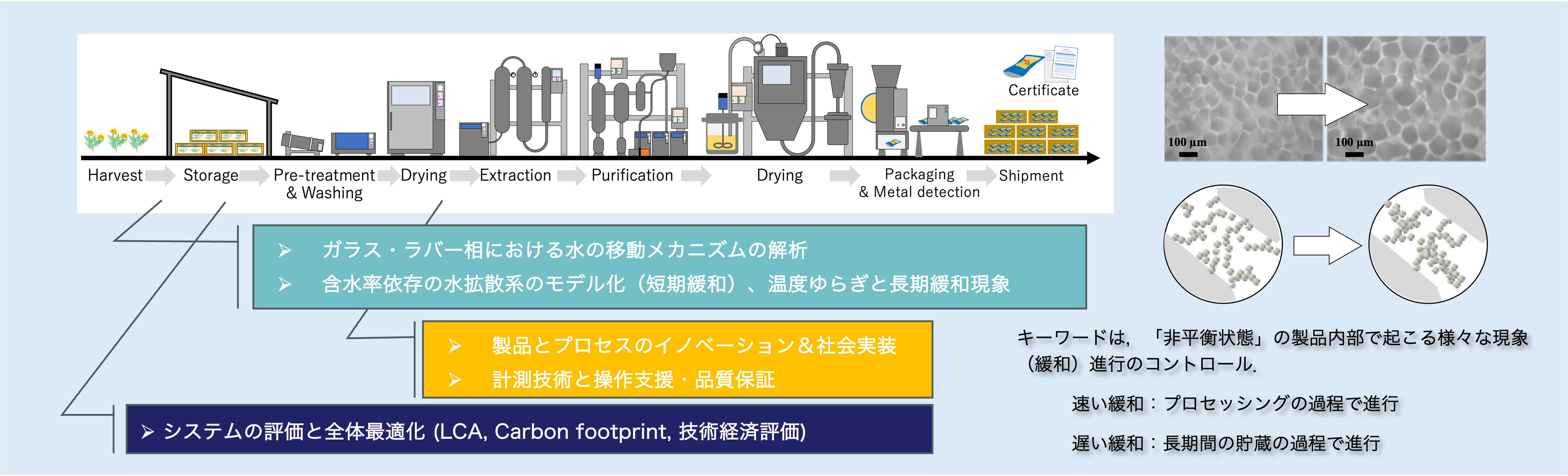
我々は日々,さまざまな工業製品の恩恵のもとにゆたかな生活を享受しています。マスプロダクションを志向した従来の工業技術の発展は,効率性の追求によって多くの人にゆたかさをもたらしました。これからの工業の発展は,人々のWell-Beingを推進し,充足性を高めるために寄与すると信じます。本研究室は,そのために必要な技術基盤の構築に貢献すべく,製造現場がより高度な生産を実現するために必要なプロセス技術の探求に取り組みます。化学工学を基盤とし,特に医薬や食品をターゲットとした技術を創出し,生産者と社会の持続性に貢献します。

We can recently enjoy a rich life thanks to the benefits of various industrial products. The development of conventional industrial technology, which is oriented towards mass production, has brought affluence to many people through the pursuit of efficiency. We believe that the development of future industry will contribute to promoting people's well-being and increasing their sufficiency. In order to contribute to the construction of the technological platform, this laboratory explores the processing technology necessary for manufacturers to achieve advanced processing. We will create technology, based on chemical engineering, that targets pharmaceuticals and food products , and contribute to the sustainability of society.
MISSION主な取り組み
乾燥/ Drying
乾燥とは材料中から水を分離除去する工業操作です。食品と関わる水は貯蔵時の物性変化や菌の増殖などと強く関わることから,これを積極的に制御することが文化的かつ工業的に実施されてきました。肉や野菜を干すことで,長期貯蔵を実現してきたのは工業以前からの人類の知恵といえますし,天日干し,燻製,塩漬け,砂糖漬け,漬け込み酒,フライ,焙煎などもすべて食品乾燥技術といえます。また,医薬品の多くが粉末状,タブレット状であることも,製剤における乾燥の重要性を伺わせます。乾燥させることで常温での運搬,流通,貯蔵が可能になりますが,服薬・投薬のしやすさ,薬効の保証などは重要な品質項目になります。
また,多くの工業プロセスに含まれる乾燥工程は,工業におけるエネルギー消費の約10〜25%を占めるともいわれています。世界の二酸化炭素排出に占める工業プロセスの寄与が約25%を占めるとすれば,乾燥プロセスにおける2割のエネルギー削減で,総二酸化炭素排出を約0.5〜1.2%削減できることになり,これは決して小さな数字ではありません。
乾燥は単純な水分移動現象ではなく,蒸発によって継続的に熱が消費される熱と物質の同時移動現象です。乾燥材料の多くは多孔体であるため,細孔内における水(液,気体)の移動,水の移動に伴う構造変化が複合的に関わるため,その理解は非常に複雑です。本研究室では,理論と経験的知見を上手に組み合わせることによって,現場で使える乾燥モデル,製品の個別性やばらつきに対処できる方法論の開発を目指します。
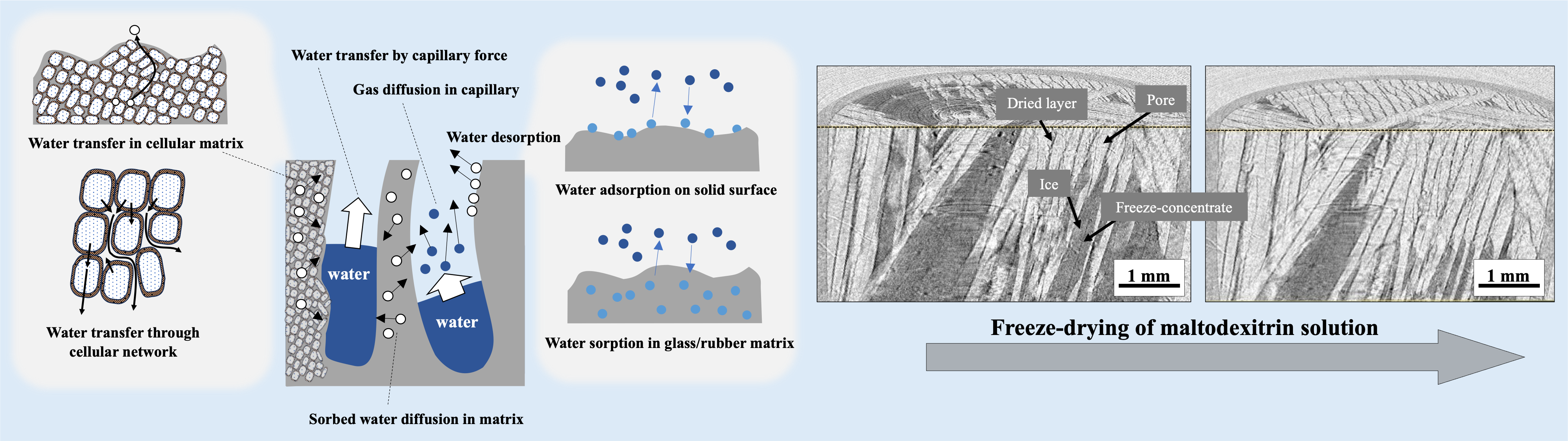
Drying is an industrial process that removes water from materials. Water in food is strongly related to changes in physicochemical properties and bacterial growth during storage, it has been actively controlled both culturally and industrially. Drying meat and vegetables to achieve long-term storage is an example of human wisdom. Sun-drying, smoking, salting, candying, pickling, frying, roasting, etc. can all be food drying techniques. The fact that many drugs are in powder or tablet form also shows the importance of drying in pharmaceutical formulation. Drying realizes easy transport, distribute and store products at room temperature. It is an important quality factor for ensuring that the drugs are easy to take and that their efficacy is guaranteed.
Drying accounts for approximately 5%–10% of the energy consumed in industrial processes. The contribution of industrial processes to global carbon dioxide emissions is about 25%, then a 20% reduction in energy use in the drying process would reduce total carbon dioxide emissions by about 0.5 to 1.2%, which is not a small figure.
Drying is a phenomenon in which water and heat move at the same time, and heat is continuously consumed through evaporation. Since drying matters are commonly porous and deforming system, the understanding of drying is very complex. It involves the combined effects of the movement of water (liquid and gas) within the pores and the structural changes that accompany the movement of water.
In this laboratory, we aim to develop practical drying model that can deal with the individuality of products by combining theory and empirical knowledge.
凍結/ Freezing
溶液を含む材料を凝固点以下に冷却すると,溶媒(水)の一部の結晶化が始まります。これが凍結の開始です。溶媒が結晶相になることで,溶液は必然的に高濃度となり,これを凍結濃縮相と呼びます。さらに冷却すると液相である凍結濃縮相が凝固し,完全固化状態となります。凍結とはこのように材料中の成分を固体化させることで,保存性を高めることができます。食品や医薬品の冷凍操作として様々なシーンで広く実施されています。
凍結過程の製品中では,氷の形成による構造化が起こります。また,凍結保存の過程であっても,材料内部では様々な現象がゆっくりと進行します。細胞組織や高次構造を持つ材料において,これらの現象は品質と直結する重要な因子となりますが,それらを制御することはいまだに困難です。本研究室では,医薬品や食品のモデル物質中で,凍結過程で進行する様々な現象のダイナミクスの理解と,その制御技術の創出に取り組みます。

When a material containing a solution is cooled below its freezing point, crystallization of part of the solvent (water) begins. This is the start of freezing. As the solvent forms the crystalline phase, the remaining solution becomes more concentrated, and this is called the freeze concentrated phase. Freeze concentrated phase is frozen at an even lower temperature, and the system is completely solidified. Freezing is a process that solidifies the components in a material, thereby improving its preservability. It is used in a variety of situations, most notably in the food and pharmaceutical industries.
During the freezing process, the formation of ice causes structural deformation in the product. In addition, even in a frozen state, various phenomena slowly progress within the material. This is because materials that have been frozen at normal speed have not yet reached equilibrium. In materials with cellular tissue or higher-order structures, these relaxation phenomena are critical factors that directly impairs expected functionality. But controlling those relaxation phenomena is still challenging.
In this laboratory, we are studying the dynamics of the phenomena that progress in a frozen state using model systems, with the aim of creating control technologies for them.
貯蔵/ Preservation
乾燥も凍結も材料中の水を制御することで貯蔵性を高めることを期待して実施します。これらを組み合わせて,凍結乾燥(フリーズドライ)という工法を実施することもできます。しかし,いずれの場合においても,製品の貯蔵の過程において様々な現象は停止することなく,ゆっくりとですが品質は劣化していきます。この劣化のダイナミクスは,貯蔵環境(温度,湿度など)の影響を強く受けます。製品の特性に応じて,最適な貯蔵環境条件があるはずですが,製品が流通,消費される過程でこれを守ることは簡単ではありません。製品の品質を保証する必要のある生産者は,大幅な余裕をみこんでその保証期間と条件を設定しているのが現状です。
製品の貯蔵性を高めるためには何が必要でしょうか?もし技術的な工夫で,製品の品質保証期間を大幅に延長できるとすれば,品質保証期限切れによる製品の廃棄ロスを減らすことができないでしょうか?また,このようなアプローチは,持続可能な社会の構築にどの程度貢献できるでしょうか?本研究室ではこれらの課題に応えたいと考えます。
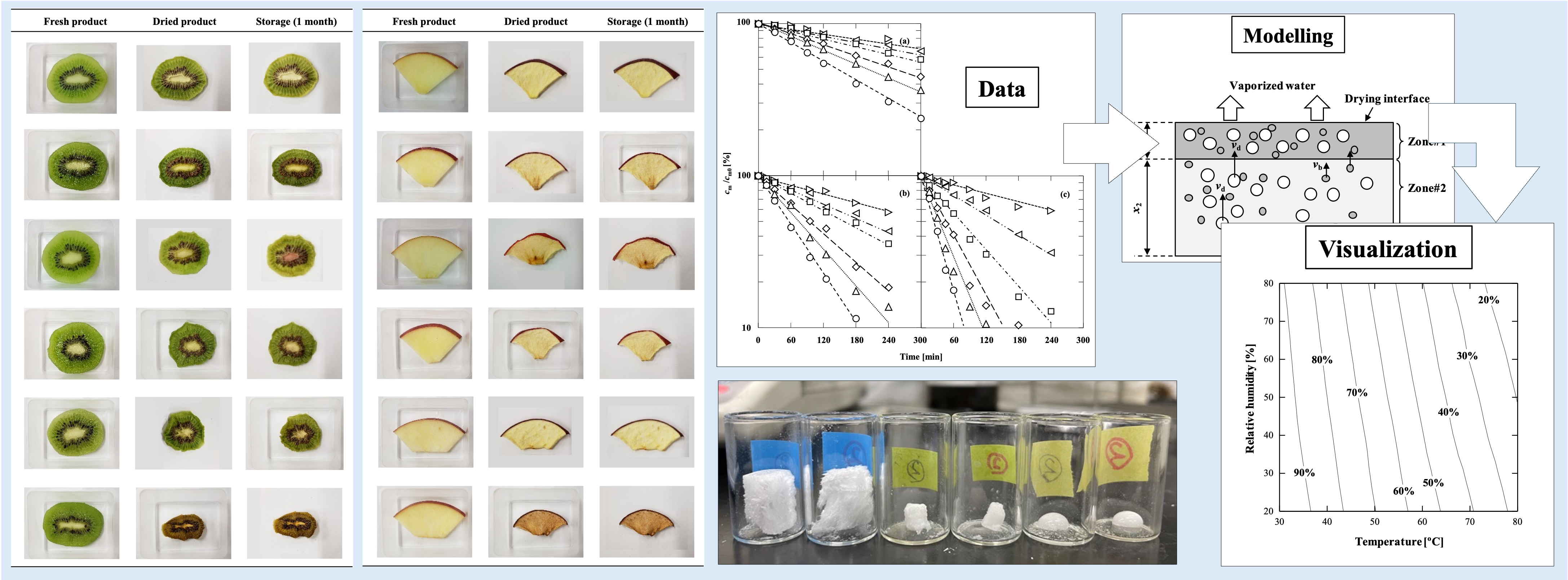
Both drying and freezing are carried out with the aim of improving the shelf life of the product by managing the water within the material. These processes can also be combined to achieve freeze-drying (lyophilization). However, in all cases, various phenomena occur even under the preservation, and the quality of the product will slowly deteriorate. The dynamics of this deterioration are strongly influenced by the temperature, humidity and their fluctuations. There are probably optimal storage conditions for each product, but it is not easy to maintain these conditions during the distribution and consumption. Producers who need to guarantee the quality of their product currently set their warrantly periods and conditions with a large safety margin.
What is needed to improve the shelf life of products? If it were possible to significantly extend the quality guarantee period through technological innovation, would it be possible to reduce the loss of products due to disposal after the expiration of the guarantee period? And to what extent could such an approach contribute to the creation of a sustainable society? This laboratory aims to address these issues.
TOPICS研究テーマ
医薬・食品の高度貯蔵を目指す基礎研究 /Advanced preservation techniques
・温度ゆらぎ下での冷凍貯蔵が構造緩和ダイナミクスに与える影響
(Relaxation dynamics under freezing with temperature fluctuations)
・凍結濃縮相内でのタンパク質凝集ダイナミクスの解明
(Protein aggregation dynamics in the freeze-concentrated phase)
・乾燥製品への吸湿が引き起こす化学反応ダイナミクスの解明
(Chemical reaction kinetics caused by moisture sorption in dried products)
凍結乾燥装置・プロセス開発 /Freeze-drying equipment and process
・噴霧凍結乾燥によって作製した乾燥粉体の特性評価
(Characterization of dried powders produced by spray-freeze-drying)
・常圧凍結乾燥プロセスによる食品物性の制御
(Atmospheric-freeze-drying of food products with controlled properties)
異相分離を利用した構造化・機能制御 /Control of material structure and functionality
・乾熱操作(熱蔵操作)を利用したタンパク質の消化性改質
(Modification of protein digestibility by dry-heat-treatment)
・凍結濃縮を利用した食品ゲルのミクロ構造制御
(Microstructure control of food gels by freeze concentration)
医薬・食品のモデルベース品質保証 /Model-based quality-by-design for pharmaceuticals and foods
・輻射加熱式凍結乾燥プロセスのモデル化
(Modeling of radiation heat assisted freeze-drying processes)
・バイオ製品の品質安定化のための要素技術開発
(Stabilization of the characteristics and functionality of bioproducts)