| ホーム | 渡辺教授 | 研究 | 業績 | 装置 | メンバー | 卒業生 | 学生業績 |
| 講義 | 学会報告 | 入学希望者 | トピックス | サイトマップ |
論文題目「Nanoparticle Synthesis of Refractory Transition Metal Nitride and Oxynitride by Induction Thermal Plasma」
Kaiwen Zhang
| 講義 | 学会報告 | 入学希望者 | トピックス | サイトマップ |
論文題目「Nanoparticle Synthesis of Refractory Transition Metal Nitride and Oxynitride by Induction Thermal Plasma」
Kaiwen Zhang
Refractory transition-metal nitrides (TMNs) and oxynitrides (TMONs) nanoparticles
attract much attention with excellent thermal and chemical stability, mechanical
properties, superconductive properties, and Cu diffusion inhibition. The
unique characteristics endow TMNs and TMONs with large application potential
on the field of hard coatings, integrated circuit, superconductor, and
visible light responsive photocatalytic materials.
The modifications including doping heteroatoms and tailoring chemical composition and crystal structure can bring enhanced physiochemical properties of TMNs and TMONs nanoparticles including suitable band-gap structure, enhanced catalytic performance, and tunable mechanical properties. Conventional nanomaterial synthesis methods face disadvantages like long synthesis time, low productivity, difficult composition controlling, and high raw material cost. The TMNs and TMONs nanoparticles with high melting point are hard to be produced with large-scale and high purity via conventional synthesis methods.
Thermal plasma is suitable for producing nanomaterials with high melting point due to high enthalpy to enhance reaction kinetics, rapid quenching rate of 104 to 106 K/s, and flexible atmosphere selection. Induction thermal plasma is selected as synthesis method in this study due to unique advantages including electrodeless discharge, large plasma volume, and long residence time, compared with other conventional thermal plasma. This dissertation aims to synthesize modified tantalum nitride (TaNx), niobium nitride (NbNx), tantalum oxynitride (TaNxOy), with controllable crystal structure, chemical bonding, and heteroatom doping via induction thermal plasma for enhanced physiochemical properties and application potential.
In Chapter 1, the background and motivation are presented for selecting TaNx, NbNx, and TaNxOy as target materials. The superiority of induction thermal plasma is emphasized on the field of nanomaterial synthesis based on the conclusion from previous works. The objective of this dissertation is introduced.
In Chapter 2, tantalum nitride (TaNx) nanoparticles were successfully synthesized via induction thermal plasma. The effects of nitridation atmosphere, quenching atmosphere, and heteroatom doping were investigated on the physicochemical properties of the nanoparticles. The nitridation atmosphere was controlled by varying the NH3 flow rate. Products with high N vacancy concentration were produced under poor nitridation conditions. The N vacancies are controlled effectively via varying NH3 flow based on XPS analysis. Enhanced quenching atmosphere achieved by adjusting the flow rate of Ar quenching gas increased fraction of the high temperature phase δ-TaNx in XRD analysis. Titanium addition in the precursor produced Ti-doped TaNx, with tunable lattice constants according to the ionic radius difference between Ti and Ta based on XRD analysis. During the synthesis process, the Ta was confirmed as the first nucleation phase with the highest nucleation temperature. Nitridation of Ta nuclei and Ti doping proceeds simultaneously during condensation process. Phase transition occurs from δ-TaNx to θ-TaNx due to different formation temperatures. Titanium doping can stabilize δ-TaNx due to the low formation energy of TiN with same space group Fm-3m.
In Chapter 3, niobium nitride (NbNx) nanoparticles were successfully synthesized via induction thermal plasma. Effects of nitridation atmosphere and heteroatom doping on physicochemical properties were investigated by controlling NH3 flow rate and precursor composition. Weak nitridation atmosphere produced nanoparticles with high N-vacancy concentration based on XPS analysis. Addition of Zr, Ti, or Cr in precursor generated heteroatom-doped NbNx with tunable lattice constants due to ionic radius differences between Nb and dopant element in XRD analysis. Nitrogen vacancy concentration increased due to lattice distortion induced by heteroatom doping. During the synthesis process, the Nb nucleated first with highest temperature. Nitridation of Nb nuclei and heteroatom doping proceeds simultaneously during condensation process. The NbNx or heteroatom-doped NbNx with δ phase is formed firstly as the high temperature phase. Most of δ phase products are preserved due to stabilization of N vacancy and rapid quenching atmosphere in induction thermal plasma.
In Chapter 4, tantalum oxynitride (TaNxOy) nanoparticles were successfully synthesized via induction thermal plasma. Oxidation and nitridation atmospheres were controlled by tuning O2 and NH3 flow rates in sheath and quenching gases. Weak oxidation atmosphere produced mainly O-doped TaNx nanoparticles. Increasing O2 flow increased O doping amount in O-doped TaNx nanoparticles. The O/Ta mole ratio above 2.5 resulted in formation of Ta2O5 and γ-TaON as major products in XRD analysis. Reduced nitridation caused similar change tendency by reducing NH radical concentration. The mole ratio of N/O was controlled more effectively under different oxidation conditions due to lower Gibbs free energy of Ta oxidation reaction. The electronic structure was detected on products with different O/N mole ratio with the aid of UV-vis. The absorption ability and band-gap energy are reported to be controlled effectively by tuning the mole ratio of O/N mole in the final product. The synthesized nanoparticles exhibit application potential on the field of H2 evolution reaction photocatalyst. Under the weak oxidation atmosphere, Ta still nucleated first based on thermal equilibrium calculation. The TaO or TaO2 nucleated first due to highest vapor partial pressure when oxidation atmosphere is enhanced. Oxidation and nitridation reactions occurred simultaneously during condensation process. Different O and NH radicals concentration leads to formation of O-doped TaNx, γ-TaON, or Ta2O5 nanoparticles.
In Chapter 5, the conclusions of the dissertation and the outlook for future research are presented. In conclusion, the refractory transition-metal nitride and oxynitride nanoparticles were successfully synthesized via induction thermal plasma in this dissertation. The tuning of plasma parameters like synthesis atmosphere and precursor composition was reported to modify nanoparticles effectively by doping heteroatom and tailoring crystal structure, chemical composition, and morphology. This dissertation provides an effective fabrication method to industrially produce refractory metal based ceramic nanomaterials with high application potential on wide fields.
研究論文
国際学会
The modifications including doping heteroatoms and tailoring chemical composition and crystal structure can bring enhanced physiochemical properties of TMNs and TMONs nanoparticles including suitable band-gap structure, enhanced catalytic performance, and tunable mechanical properties. Conventional nanomaterial synthesis methods face disadvantages like long synthesis time, low productivity, difficult composition controlling, and high raw material cost. The TMNs and TMONs nanoparticles with high melting point are hard to be produced with large-scale and high purity via conventional synthesis methods.
Thermal plasma is suitable for producing nanomaterials with high melting point due to high enthalpy to enhance reaction kinetics, rapid quenching rate of 104 to 106 K/s, and flexible atmosphere selection. Induction thermal plasma is selected as synthesis method in this study due to unique advantages including electrodeless discharge, large plasma volume, and long residence time, compared with other conventional thermal plasma. This dissertation aims to synthesize modified tantalum nitride (TaNx), niobium nitride (NbNx), tantalum oxynitride (TaNxOy), with controllable crystal structure, chemical bonding, and heteroatom doping via induction thermal plasma for enhanced physiochemical properties and application potential.
In Chapter 1, the background and motivation are presented for selecting TaNx, NbNx, and TaNxOy as target materials. The superiority of induction thermal plasma is emphasized on the field of nanomaterial synthesis based on the conclusion from previous works. The objective of this dissertation is introduced.
In Chapter 2, tantalum nitride (TaNx) nanoparticles were successfully synthesized via induction thermal plasma. The effects of nitridation atmosphere, quenching atmosphere, and heteroatom doping were investigated on the physicochemical properties of the nanoparticles. The nitridation atmosphere was controlled by varying the NH3 flow rate. Products with high N vacancy concentration were produced under poor nitridation conditions. The N vacancies are controlled effectively via varying NH3 flow based on XPS analysis. Enhanced quenching atmosphere achieved by adjusting the flow rate of Ar quenching gas increased fraction of the high temperature phase δ-TaNx in XRD analysis. Titanium addition in the precursor produced Ti-doped TaNx, with tunable lattice constants according to the ionic radius difference between Ti and Ta based on XRD analysis. During the synthesis process, the Ta was confirmed as the first nucleation phase with the highest nucleation temperature. Nitridation of Ta nuclei and Ti doping proceeds simultaneously during condensation process. Phase transition occurs from δ-TaNx to θ-TaNx due to different formation temperatures. Titanium doping can stabilize δ-TaNx due to the low formation energy of TiN with same space group Fm-3m.
In Chapter 3, niobium nitride (NbNx) nanoparticles were successfully synthesized via induction thermal plasma. Effects of nitridation atmosphere and heteroatom doping on physicochemical properties were investigated by controlling NH3 flow rate and precursor composition. Weak nitridation atmosphere produced nanoparticles with high N-vacancy concentration based on XPS analysis. Addition of Zr, Ti, or Cr in precursor generated heteroatom-doped NbNx with tunable lattice constants due to ionic radius differences between Nb and dopant element in XRD analysis. Nitrogen vacancy concentration increased due to lattice distortion induced by heteroatom doping. During the synthesis process, the Nb nucleated first with highest temperature. Nitridation of Nb nuclei and heteroatom doping proceeds simultaneously during condensation process. The NbNx or heteroatom-doped NbNx with δ phase is formed firstly as the high temperature phase. Most of δ phase products are preserved due to stabilization of N vacancy and rapid quenching atmosphere in induction thermal plasma.
In Chapter 4, tantalum oxynitride (TaNxOy) nanoparticles were successfully synthesized via induction thermal plasma. Oxidation and nitridation atmospheres were controlled by tuning O2 and NH3 flow rates in sheath and quenching gases. Weak oxidation atmosphere produced mainly O-doped TaNx nanoparticles. Increasing O2 flow increased O doping amount in O-doped TaNx nanoparticles. The O/Ta mole ratio above 2.5 resulted in formation of Ta2O5 and γ-TaON as major products in XRD analysis. Reduced nitridation caused similar change tendency by reducing NH radical concentration. The mole ratio of N/O was controlled more effectively under different oxidation conditions due to lower Gibbs free energy of Ta oxidation reaction. The electronic structure was detected on products with different O/N mole ratio with the aid of UV-vis. The absorption ability and band-gap energy are reported to be controlled effectively by tuning the mole ratio of O/N mole in the final product. The synthesized nanoparticles exhibit application potential on the field of H2 evolution reaction photocatalyst. Under the weak oxidation atmosphere, Ta still nucleated first based on thermal equilibrium calculation. The TaO or TaO2 nucleated first due to highest vapor partial pressure when oxidation atmosphere is enhanced. Oxidation and nitridation reactions occurred simultaneously during condensation process. Different O and NH radicals concentration leads to formation of O-doped TaNx, γ-TaON, or Ta2O5 nanoparticles.
In Chapter 5, the conclusions of the dissertation and the outlook for future research are presented. In conclusion, the refractory transition-metal nitride and oxynitride nanoparticles were successfully synthesized via induction thermal plasma in this dissertation. The tuning of plasma parameters like synthesis atmosphere and precursor composition was reported to modify nanoparticles effectively by doping heteroatom and tailoring crystal structure, chemical composition, and morphology. This dissertation provides an effective fabrication method to industrially produce refractory metal based ceramic nanomaterials with high application potential on wide fields.
 |
 |
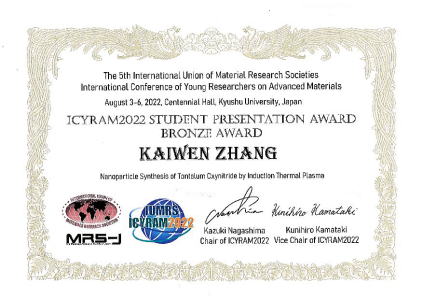
International Conference of Young Researchers on Advanced Materials Student Presentation Award (2022年9月) 「Nanoparticle Synthesis of Tantalum Oxynatiride by Induction Thermal Plasma」 |
 |
 |
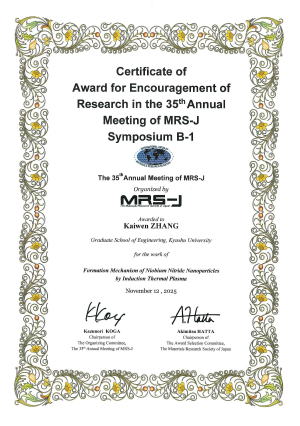
第35回日本MRS年次大会 優秀賞 (2025年12月) Formation Mechanism of Niobium Nitride Nanoparticles by Induction Thermal Plasma |
研究論文
- Yirong Wang, Kaiwen Zhang, Motonori Hirose, Junya Matsuno, Manabu Tanaka, and Takayuki Watanabe: Synthesis of Ternary Titanium-Niobium Nitride Nanoparticles by Induction Thermal Plasma, Japanese Journal of Applied Physics, 63, 09SP04 (2024.9).
- Kaiwen Zhang, Yuta Tanoue, Yirong Wang, Motonori Hirose, Manabu Tanaka, and Takayuki Watanabe: Synthesis of Tantalum Nitride Nanoparticles with Different Nitridation Atmosphere in Induction Thermal Plasma, IEEE Transactions of Plasma Science, 53 (7), p/1772-1779 (2025.7).
- Yirong Wang, Kaiwen Zhang, Manabu Tanaka, and Takayuki Watanabe: Formation Mechanism of Titanium-based Transition Metal Nitride Nanoparticles Synthesized by Radio Frequency Induction Thermal Plasma, Inorganic Chemistry, 64 (45), p.22355-22366 (2025.11).
- Student Presentation Award Kaiwen Zhang, Yuta Tanoue, Manabu Tanaka, and Takayuki Watanabe: Nanoparticle Synthesis of Tantalum Oxynatiride by Induction Thermal Plasma, The 5th International Union of Materials Research Societies International Conference of Young Researchers on Advanced Materials, C-O4-002, p.116 (2022.8.4 Kyushu University).
- Kaiwen Zhang, Manabu Tanaka, and Takayuki Watanabe: Nanoparticle Synthesis of Heteroatoms-Doped ZrN by Induction Thermal Plasma, 32nd Materials Reserch Society of Japan, E-O6-005 (2022.12.6 Yokohama, Industry & Trade Center Building).
- Yirong Wang, Kaiwen Zhang, Kohei Yamashita, Manabu Tanaka, and Takayuki Watanabe: Synthesis of Ternary Ti1-xNbxN Nanoparticles by Induction Thermal Plasma, 32nd Materials Reserch Society of Japan, E-O5-018 (2022.12.5 Yokohama, Industry & Trade Center Building).
- Kaiwen Zhang, Manabu Tanaka, and Takayuki Watanabe: Nanoparticle Synthesis of Heteroatoms-Doped ZrN by Induction Thermal Plasma, 2022 International Industry-University-Research-Application Cooperation Conference (2022.12.10 On-Line).
- Han Chen, Kohei Yamashita, Kaiwen Zhang, Manabu Tanaka, and Takayuki Watanabe: Nanoparticle Synthesis of Transition Metal Oxynitride by Induction Thermal Plasma, Proceedings of 25th International Symposium on Plasma Chemistry, POS-7-103 (2023.5.22 Miyako Messe, Kyoto).
- Yirong Wang, Kohei Yamashita, Kaiwen Zhang, Manabu Tanaka, and Takayuki Watanabe: Nanoparticle Synthesis of Ternary Titanium Niobium Nitrides by Induction Thermal Plasmas, Proceedings of 25th International Symposium on Plasma Chemistry, POS-7-121 (2023.5.22 Miyako Messe, Kyoto).
- Kaiwen Zhang, Kohei Yamashita, Manabu Tanaka, and Takayuki Watanabe: Formation Mechanism of Metal-Doped ZrN by Induction Thermal Plasma, Proceedings of 25th International Symposium on Plasma Chemistry, POS-7-223 (2023.5.23 Miyako Messe, Kyoto).
- Kaiwen Zhang, Manabu Tanaka, and Takayuki Watanabe: Nanoparticle Formation Mechanism of Metal-Doped ZrN by Induction Thermal Plasma, 2023 International Industry-University-Research-Application Cooperation Conference (2023.12.16 On-Line).
- Yirong Wang, Kaiwen Zhang, Han Chen, Motonori Hirose, Manabu Tanaka, and Takayuki Watanabe: Synthesis of Tenary Titanium-Transition Metal Nitrides Nanoparticles by Induction Thermal Plasmas, 16th International Symposium on Advanced Plasma Science and Its Applications for Nitrides and Nanomaterials, 05aC03O (2024.3.5 Nagoya University).
- Kaiwen Zhang, Motonori Hirose, Yirong Wang, Junya Matsuho, Manabu Tanaka, and Tlalayuki Watanabe: Synthesis of Tantalum Nitride Nanoparticles by Induction Thermal Plasma, The 51st Internatonal Conference on Plasma Sicence (2024.6.18 Beijin, China).
- Kaiwen Zhang, Yirong Wang, Motonori Hirose, Junya Matsuho, Manabu Tanaka, and Takayuki Watanabe: Formation Mechanism of Heteroatoms-Doped Tantalum Nitride Nanoparticles by Induction Thermal Plasma, The 35th International Symposium on Chemical Engineering, F03 (2024.11.30, Okinawa Prefectural Municipal Autonomy Hall).
- Kaiwen Zhang, Yirong Wang, Motonori Hirose, Manabu Tanaka, and Talayuki Watanabe: Nanoparticle Synthesis of Heteroatoms-Doped Tantalum Nitride Nanoparticles by Induction Thermal Plasma, 25th Workshop on Fine Particle Plasmas, PO-1 (2025.1.16 National Institute for Fusion Sicence).
- Kaiwen Zhang, Manabu Tanaka, and Talayuki Watanabe: Nanoparticle Synthesis of Niobium Notride by Induction Thermal Plasma, The 14th Asian-European International Conference on Plasma Surface Engineering (2025.11.3 Phuket, Thailand).
- 田中学, Zhang Kaiwen, 渡辺隆行: 高周波熱プラズマを用いたTa酸窒化物ナノ粒子の組成制御, 第37回九州・山口プラズマ研究会資料集, p.12-13 (2022.11.6).
- Han Chen, Yirong Wang, Kaiwen Zhang, 廣瀨基規, 田中学, 渡辺隆行: 高周波熱プラズマを用いた高融点金属酸窒化物ナノ粒子の合成, プラズマ・核融合学会九州・沖縄・山口支部第27回支部大会研究発表論文集, p.75-76, D-2 (2023.12.10 KDDI維新ホール).
- 田中学, 陳翰, 張楷文, 王芸融, 廣瀨基規, 渡辺隆行: 高周波熱プラズマによるタンタル酸窒化物ナノ粒子の合成, 第41回プラズマプロセシング研究会, 24a-3 (2024.1.24 東京工業大学).
- Zhang Kaiwen: Formation Mechanism of Tantalum Nitride Nanoparticles Synthesized by Induction Thermal Plasma, 化学工学会九州支部第29回学生審査会 (2024.7.20 北九州市立大学ひびきのキャンパス).
- Kaiwen Zhang, Manabu Tanaka and Takayuki Watanabe: Formation Mechanism of Niobium Nitride Nanoparticles by Induction Thermal Plasma, 第35回日本MRS年次大会, B1-010-004 (2025.11.10 北九州国際会議場).

